Story
The Jezdić family story
This is the longer version of the story the home page only hints at. If that was a short trailer — this is the whole film.
The estate
Our story begins in the autumn of 1999. Spontaneously, almost haphazardly, in the time after the bombing, when a great many things had to be built again from nothing. Its roots, though, run much deeper.
In 1943, on an inherited homestead in the village of Zabrdica near Valjevo, the family suffered terribly when a German punitive expedition burned the houses along the main road. That night only ruins and orphans remained in the village — but a small estate of some 60 ares survived. The last keeper of the family hearth was a great-aunt on the mother's side.
The first memories of the village are childhood images: riding grandmother's ram, the rented still where plum was distilled, scenes and sayings you remember for life. And yet for a long time, in keeping with youthful enthusiasm and inexperience, the wish was to build a life and a career somewhere else.
The turning point came one winter evening in the early 1990s. Visiting the snowbound estate — which, because of the economic crisis and studies in Belgrade, was meant to be sold — the stillness struck clear, the air was clean, and the glint of snow was seen for what it was. Out of responsibility to nature and to those who came before, we gave up on selling land that at the time was worth nothing. Instead, a new idea arrived: that if the chance ever came, the estate would be widened and restored.
Though it seemed distant and all but impossible then, a few years later, after the first roles in the theatre and on television, another 50 ares were bought.
That is the ground our distillery stands on today.
The first production
In the years that followed, alongside the acting career, the estate grew step by step. New hectares were bought, and the first plantings were made in 1999. Inspired by his daughters and by Chekhov's play, that is when our first cherry orchard came to be.
By 2002 nearly 10 tonnes of sour cherries were picked — and that is when we first met the farmer's oldest grievance and the reality of agriculture: the uncertainty of the market. You grow it, you tend it, you pick it, and you do not know whether or how you will be paid for it. That decisive year the buyer first offered a good price, then tried to break the value of a first-class crop once it had been delivered.
That is when we made what turned out to be the decisive choice. We will not give the fruit away for nothing. We will make rakija out of it.
We borrowed a still and the equipment and, with the help of our friend the technologist Miša Cilić, distilled the first batches that year. Out of inexperience and instinct, part of it rested in wood — and it was precisely that rakija that won our first grand gold a few years later.
Faith, vision and growth
Every year since has been a year of buying and growing fruit, of household-scale production turning more and more serious. Only when there was no longer any place to store it, in 2011, did the sale of rakija begin.
All the while, every income was invested back into the estate. Machinery, orchards, buildings — everything built with great sacrifice. For years almost the whole property was under mortgage, with one clear aim: to build a sustainable, authentic homestead. From the outside it often looked irrational; on the inside the vision was perfectly clear.
Alongside the estate, the acting life ran on. The two worlds never fought — they completed each other. The village taught discipline, patience, and the facing of what cannot be controlled. The theatre, on the other hand, imagination, vision, and the steady need to make.
The craft was learned from books, at the Faculty of Agriculture, and from the experience of other householders, neighbours and friends. Along the way, experts generously shared what they knew: Miša Cilić, Peđa Vukosavljević, Ljubiša Stanković, and professor Ninoslav Nikićević.
From field to bottle
For us, rakija is made in the orchard. Everything that follows — fermentation, distillation, ageing — is only the continuation of that work. Which is why the basis of everything we do is a simple but demanding idea: a million percent of a hundred percent fruit.
A sonorous phrase — but one that stands for complete devotion to every step from field to bottle: the millions of decisions, movements, furrows, hours of work, leaves, seasons and fruits behind a single glass.
Today, after nearly three decades, the imperative of quality and continuity is unchanged, and the work is as devoted, as traditional and as hand-made as it ever was. We grow our own fruit on about 50 hectares, and from it, in limited batches, come the plum, sour cherry, pear and quince rakijas — and the honey one.
Every bottle of Jezdić rakija has come out of years of effort — and out of a clear decision to produce and sell only what we can proudly stand behind by name.
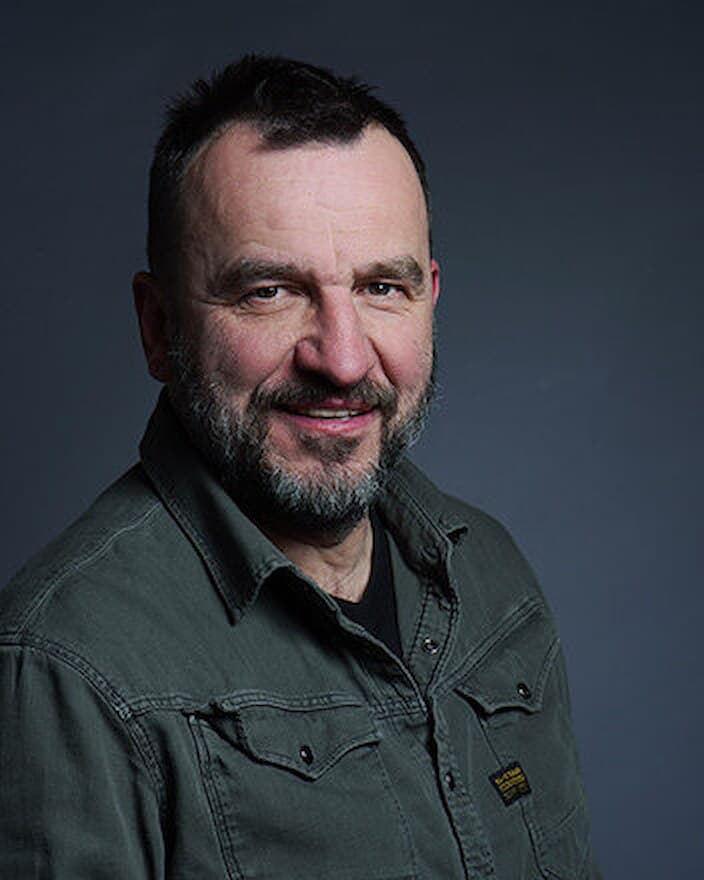
The narrator
Nenad Jezdić
Actor and host. He planted the first cherry orchard inspired by Chekhov's play and by his daughters. He made the first rakija out of defiance, in 2002, when the buyer tried to break his price. He likes to say that by our rakija, our grandchildren will know what kind of people we were.
Искусни и мудри људи знају да је наша домаћа ракија много више од алкохолног пића, јер њен почетак није на казану, нити је њен крај на трпези.
A Word on Rakija